


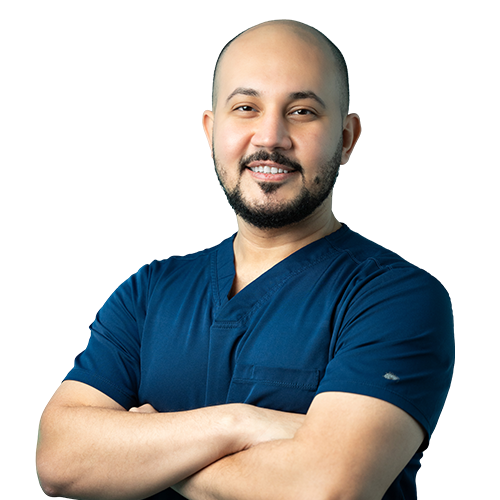
Dr. Ahmed Sayed is a specialist endodontist Al Ain patients can visit at Bloom Dental Center for microscopic root canal treatment. His work focuses on saving natural teeth by treating the root canals and the tissues around them with the help of a dental operating microscope.
Root canal treatment is one of the procedures that decides how long a natural tooth can stay in the mouth, especially when it is carried out carefully and completely. Dr. Ahmed Sayed uses a dental operating microscope in all of his root canal procedures, which allows him to see the fine anatomy inside the tooth much more clearly than with the naked eye.
Why Choose Dr. Ahmed Sayed as Your Endodontist in Al Ain?
- ►Microscopic root canal treatment, using a dental operating microscope in all procedures.
- ►Diagnosis and treatment of complex, narrow, and curved root canals.
- ►Retreatment of root canals that were unsuccessful or became reinfected.
- ►Treatment of abscesses and apical lesions to preserve the natural tooth.
- ►Removal of broken instruments (files) from inside the root canals.
At Bloom Dental Center, Dr. Ahmed Sayed treats each tooth with one aim: to keep the natural tooth whenever it can be saved. Every case begins with a clear diagnosis, and the treatment plan is explained to the patient before any work starts.
Microscopic Root Canal Treatment in Al Ain
Root canals are small and often irregular. Some are very narrow, some are curved, and some have extra branches that are easy to miss without magnification. When a canal is missed or not fully cleaned, infection can remain inside the tooth and cause pain or swelling later.
The dental operating microscope gives Dr. Ahmed Sayed magnification and strong light inside the tooth. This helps him locate the canals, clean them, and seal them carefully, which supports the long-term survival of the tooth. As an endodontist Al Ain patients can consult at Bloom Dental Center, he uses the microscope in every root canal case, not only in the difficult ones.
Complex Root Canals and Root Canal Retreatment
Some teeth have complex anatomy, such as narrow, curved, or calcified canals. These cases need careful diagnosis and patience, and the microscope makes it easier to follow the canal to its end.
In other cases, a tooth that was treated before becomes painful or reinfected. This can happen when the earlier treatment did not reach all the canals or did not seal them well. Dr. Ahmed Sayed carries out root canal retreatment: he removes the old filling material, disinfects the canals again, and seals them so that the tooth can be kept. We aim to complete treatment in as few visits as each case allows. Patients looking for an endodontist Al Ain trusts with retreatment cases can book a consultation to assess whether the tooth can be saved.
Abscesses, Apical Lesions, and Broken Instruments
A chronic infection at the tip of the root, known as an apical lesion or abscess, does not always mean the tooth must be extracted. As an endodontist Al Ain patients consult for this problem, Dr. Ahmed Sayed often finds that cleaning and disinfecting the canals properly allows the infection to heal and the natural tooth to stay in place.
Sometimes a fine instrument (file) breaks inside a canal during a previous treatment. Dr. Ahmed Sayed removes these fragments using micro-endodontic techniques and the microscope, taking care to protect the tooth structure. Whether a fragment can be removed depends on its position and the shape of the canal, so each case is assessed individually.
What to Expect During Your Visit
Every consultation with Dr. Ahmed Sayed begins with an assessment of the tooth and your symptoms, often supported by digital imaging to plan the treatment. He then explains the diagnosis, the options, and the steps of treatment, so you know what to expect before starting.
If you have tooth pain, swelling, or a tooth that was treated before and still bothers you, you can meet a specialist endodontist Al Ain patients rely on for microscopic root canal care. Book an Appointment or Contact Us for a consultation. You can also read more about our root canal treatment services, or learn about root canal care from the American Association of Endodontists.
Frequently Asked Questions About Root Canal Treatment
When do I need root canal treatment?
A root canal may be needed when the nerve inside the tooth is inflamed or infected, for example after deep decay or a crack. Common signs include lasting pain, sensitivity to heat or cold, or swelling near the tooth. Only an examination and an X-ray can confirm the need.
What does the microscope add to root canal treatment?
The dental operating microscope provides magnification and strong light inside the tooth. This helps the specialist find narrow or hidden canals, clean them, and seal them carefully.
Can a tooth that was treated before be treated again?
In many cases, yes. Root canal retreatment removes the old filling material, disinfects the canals again, and seals them. Whether it is suitable depends on the condition of the tooth, which is assessed at the consultation.
Can a tooth with an abscess be saved?
Often it can. Cleaning and disinfecting the canals properly can allow the infection to heal without extracting the tooth. This depends on the case, so an assessment comes first.
How many visits does root canal treatment take?
It varies from case to case, depending on the tooth and the infection. We aim to complete treatment in as few visits as each case allows.